
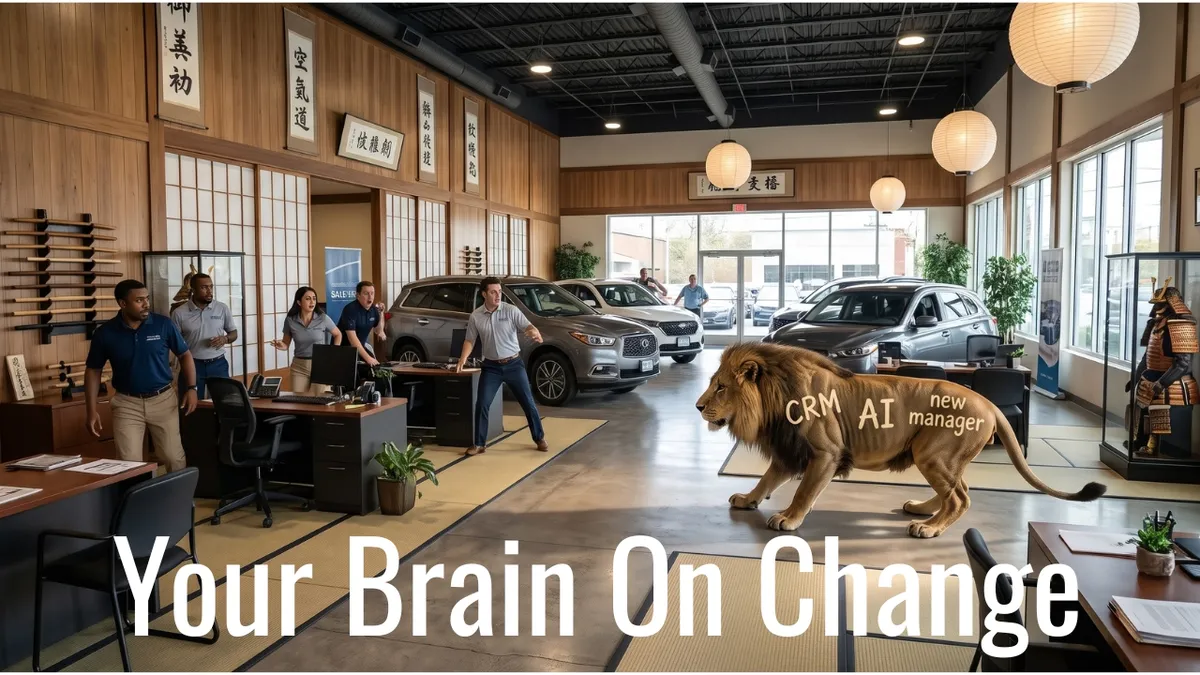
Your Brain On Change
Your Brain Thinks the New CRM Is a Lion
Why change feels dangerous, and how to train your way out of it.
What does a lion charging at you have in common with a CRM migration?
To the part of your brain that handles threats, not much...it treats them about the same. Which explains the mood in your store the week the new system goes live.
Your Brain Is a Prediction Machine
Your brain is a prediction machine. Every second, it forecasts what happens next based on everything it has learned. When reality matches the forecast, you relax. When it doesn’t - a new system, new process, new manager, a customer who won't follow your practiced script - your brain throws what scientists call a prediction error. Translation: "Hey. Pay attention. Something is off!"
In The Physiologist, researchers note that large prediction errors are genuinely stressful: they signal something important might be wrong.
Meet Your Stress System
That alarm runs through the HPA axis — hypothalamus, pituitary, adrenal — a three-stop relay race. The hypothalamus, your brain's command center, sounds the alarm with a hormone called CRH. The pituitary answers with ACTH. Your adrenal glands, on top of your kidneys, release cortisol. Cleveland Clinic calls it a communication system between three organs with cortisol as the finish line.
Cortisol isn’t the villain. In the short term it’s awesome: it mobilizes energy, sharpens attention and gets you moving. It even comes with an off switch: cortisol signals back to the brain to shut the alarm down.
The trouble starts when the alarm never shuts off. Research links a dysregulated HPA axis to a long list of stress conditions. A 2026 study in Translational Psychiatry reports that chronic stress impairs feedback in the brain regions that regulate the response, including the prefrontal cortex, your planning center.
When that weakens, impulse control and empathy are first out the door. Translation for the service drive at 4 p.m., when every customer from that day come to pick up their vehicles at the same time? A shorter fuse, worse decisions and less patience.
The Lion Problem
Your stress system can’t tell a charging lion from another software update or management turnover. To your brain, unpredictability is unpredictability.
And a dealership might be the most unpredictable workplace on earth. New tools. New pricing. New AI. Turnover. A customer who was upset before they even parked in your parking lot. If you live in constant prediction errors, the alarm never gets to switch off.
The Great News: This Is Trainable
Scientific American has described how the brain learns to cope with uncertainty, and a study in Scientific Reports found that emotional regulation and cognitive flexibility protect against it. Tolerance for uncertainty is trainable, and you train it the way you trained every other habit you own. Repetition over time.
Remember Seligman from our Wired to Win series about learned helplessness? He and Steven Maier found that when creatures learn that nothing they do changes the outcome, they stop trying — even after the escape door opens. Helplessness is learned. But his work on learned optimism showed the flip side: the same brain that learned to give up can learn to try again. Napoleon Hill made the same point about the subconscious: it just runs the pattern it was trained to run, before your conscious mind is awake.
You’ve Been Practicing the Wrong Reps
Every automatic reaction you have, you built. Including the ones you’re not proud of: the eye-roll at the new software, the sigh before the new process, the pause before "that will never work here." Your brain is excellent at those. You’ve put in a lot of reps.
As Dave Anderson puts it in Elevate Your Excellence, the antidote isn’t willpower. It’s small, ordinary, repeatable actions, every day, especially the days you don’t feel like it. Every Day Means Every Day.
Old patterns aren’t deleted, though. Your brain builds a new response that competes with the old one, and it wins by “out-repping” it, ideally in the same situations where the old one shows up. Dr. Phillippa Lally found a median of 66 days to make a daily behavior automatic, ranging from 18 to 254. One missed day didn’t derail it, but after that the old habit gets easier to fall back into.
The Loop That Changes Everything
Every time you lean into a little uncertainty and come out fine — which you almost always do — you are building self-efficacy: your belief that you can handle this specific thing. Not general confidence — specific. I can learn this system, because I’ve learned systems before.
Albert Bandura named four sources:Mastery Experience:doing the thing and succeeding even a little, the strongest of the four; Vicarious Experience: watching someone like you pull it off; Verbal Persuasion: a manager who says "you've got this" and means it; and How You Read Your Won Body: reading your own racing heart as excited and ready instead of panicked.
See the loop? A small lean-in to discomfort becomes a mastery experience, which builds self-efficacy, which makes the next lean easier. Avoid it, and your comfort zone shrinks while the alarm gets louder. Lean in, and it grows.
Why This Matters
Tolerance for uncertainty is a muscle, and the pace of change isn’t slowing down for anyone, in fact, it’s exactly the opposite. Every small rep to execute is a mastery experience, the strongest proof your brain will accept. Writing down "I’ve handled new things before and succeeded," is an argument your brain can’t ignore.
That’s how you teach your stress system that unfamiliar does NOT mean dangerous.
It is a CRM update. Not a lion. You’ve got this!