The War Nobody Wins
The War Nobody Wins
When the Need to Be Right Costs You More Than You Realize
Somewhere in a dealership today, a manager is yelling at an employee who screwed something up.
A salesperson is arguing with a customer who is absolutely convinced their trade is worth $5,000 more.
Service is blaming sales. Sales is blaming service. Parts is irritated with everybody.
And somewhere at home tonight, somebody‘s going to continue the same festivities with their spouse.
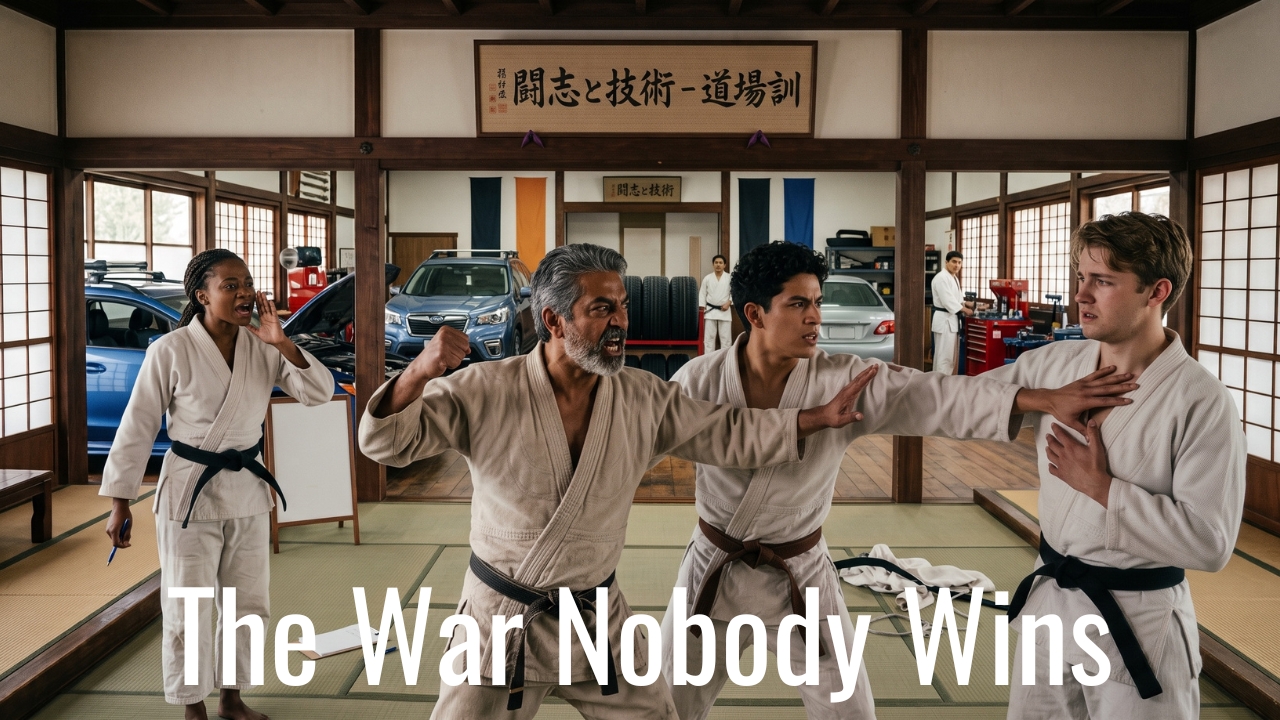
Welcome to Level 2 Energy—where everybody wants to win, and somehow everybody ends up losing.
Level 2 Energy, as defined in the Energy Leadership framework from iPEC (The Institute for Professional Excellence In Coaching - Bruce Schneider), is catabolic (heavy, negative, destructive) energy driven primarily by anger, conflict, judgment and force. Its underlying philosophy is simple:
“I win. Therefore, you lose.”
It’s incredibly prevalent in business and in life because, frankly, it can work. At least temporarily.
Anger creates action. Fear creates compliance. Force can produce results. But there’s a huge difference between getting results and creating sustainable success.
When Winning Becomes More Important Than the Outcome
Level 2 sees the world in black and white. Right or wrong, weak or strong, winner or loser. And once you’ve decided the person across from you is wrong, curiosity disappears.
Think about what happens when an angry customer walks up to you in your dealership. They’re already operating from Level 2.
Maybe they were stuck in traffic on the way in and are late to their appointment. Perhaps the payment isn’t what they expected. Their vehicle isn’t ready. Their service took twice as long as promised or they’re back in service for another recall.
They come at you hot.
And what happens if you meet them there? They raise their voice. You raise yours. They defend. You defend.
Congratulations. You’re now participating in an argument nobody can win.
Even if you prove the customer factually wrong, what exactly have you won? You may have won the argument and lost the customer.
The Five-Second Decision
This is where emotional intelligence becomes incredibly valuable.
When you feel Level 2 rising—the tightening jaw, faster heartbeat, heat in your face, that delicious urge to explain to another human being exactly why they’re wrong—stop.
Take a deep breath.
Seriously.
That tiny pause creates space between what happened and what you do next. You don’t have to accept abusive behavior. You don’t have to agree with something that isn’t true. You’re simply refusing to surrender control of yourself.
Instead of taking it personally and matching the customer's anger, lower your pushback, get curious and ask:
“What happened?”
“Help me understand.”
“What would a good resolution look like for you?”
You’re no longer fighting the customer. You’re standing beside them and fighting the problem together. That shift can transform the entire customer experience.
Leadership Through Fear Works—Until It Doesn't
Level 2 may be even more expensive in leadership.
The team isn’t executing, numbers are down, processes aren’t being followed. So frustration builds until eventually the manager explodes.
“HOW MANY TIMES DO I HAVE TO TELL YOU PEOPLE THIS?”
Maybe everyone suddenly moves faster.
See? It worked!
Except now your employees aren’t executing because they’re engaged. They’re executing because they want the yelling to stop or they’re fearful for their jobs - and they will do JUST enough to avoid both.
Keep leading that way and something else happens.
People stop bringing you problems, they hide mistakes, they stop offering ideas and your strongest employees leave. And the people who remain learn to manage you instead of managing the business.
Fear can create compliance, but it rarely creates commitment.
Auto Dojo's principles of integrity, respect for the individual, empowerment through support and leading by example demand something higher: hold the standard without destroying the person.
And remember: accountability and anger are not the same thing.
Maybe It Was Never About Winning
Carol Dweck’s work on fixed and growth mindsets mentioned in her book, Mindset, offers another interesting lens.
When your identity depends on proving your competence, being wrong can feel threatening. Suddenly a disagreement isn't just about an idea, iIt feels like a judgment of you.
So you defend harder, attack faster and always need to have the last word.
And sometimes anger is covering something underneath it: insecurity, embarrassment, fear of criticism or the possibility that maybe—brace yourself—maybe YOU actually screwed up.
But the strongest person in the room doesn't need to win every argument…they need enough self-command to choose the response that serves the outcome.
Stop Fighting Things You Can't Control
Stephen Covey gave us another powerful tool in The 7 Habits Of Highly Effective People: the Circle of Concern versus what we can actually influence and control.
You can't control interest rates, corporate policies, the economy, your coworker's personality, the survey somebody wrote six months ago or the mood your customer brought through the front door.
You can control your preparation, effort, attitude and response. Yet we burn enormous amounts of emotional fuel fighting things we were never going to control in the first place.
And this doesn't stop at the dealership.
We do it with spouses, family, traffic, the economy, politics…and often we direct that fight towards ourselves.
Self-directed Level 2 can be brutal: You idiot. Why did you do that? Why can't you get your sh** together? We'd never coach another human being that way and expect greatness, yet somehow we think abusing ourselves will produce excellence.
It won't.
Living constantly angry and activated also keeps the body under stress. What begins as an emotional habit can eventually affect sleep, relationships, decision-making and overall well-being.
Strength Is Choosing Your Energy
The goal isn't eliminating anger, because anger contains energy, and sometimes it’s needed in small doses. The question is: Who's controlling whom? And when does it create damage?
The next time you feel Level 2 rising, take one breath before responding. Then ask:
“Am I trying to improve this situation—or am I trying to win?”
And if something has been eating at you, borrow from Covey. Ask whether it belongs in your Circle of Concern or your Circle of Control. If you can't control it, stop feeding it. Redirect that energy toward something you can change, because real strength isn't overpowering the customer, your employee, your spouse—or yourself…it's having enough command over your own energy to choose the response that creates the best possible outcome.
Anybody can fight fire with fire.
Excellence is knowing when to put the match down before you burn the house down.
If you’re ready to understand where you go when pressure hits—and learn how to choose a different response, CLICK HERE to discover the Energy Leadership Assessment and uncover the patterns that may be shaping your reactions, relationships, and results. Your triggers don’t have to run your life. You get to choose what happens next.