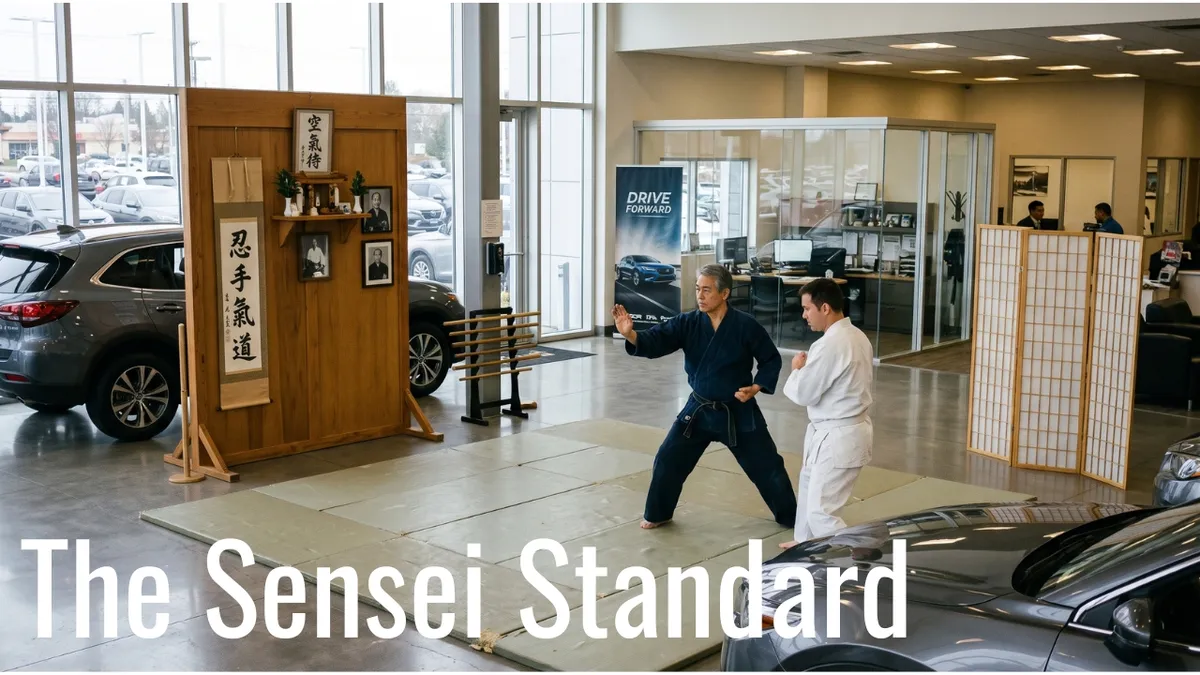
The Sensei Standard
Every Black Belt Has a Sensei: Find Yours
Think about the last time you surprised yourself by being better at something than you ever thought you could be. Now be honest. Did you get there alone, or did someone push you, believe in you, and stay in your corner until you did?
I'm guessing it wasn't a solo mission. Nobody earns a black belt by watching YouTube in their pajamas. Every black belt has a sensei. Let’s talk about finding yours.
Why Watching Greatness Changes You
Psychologist Albert Bandura spent decades studying how people learn, and he found something simple: we learn by watching others. He broke it into four steps. You pay attention to someone, you remember what they did, you try it yourself, and you stay motivated to keep going.
Here's the powerful part. Watching someone succeed raises what Bandura called self-efficacy: your belief that you can do it too. Your brain stops filing the goal under "impossible" and starts filing it under "somebody I know did it."
Roger Bannister showed this on a track. For decades, experts said no human could run a mile in under four minutes. In 1954, Bannister did it. Within about two months, another runner, John Landy, broke the barrier too. Then more followed. The human body didn't change that summer. The belief did.
The Right Role Model Matters
Not every role model helps, though. Psychologists Penelope Lockwood and Ziva Kunda found that people get inspired by someone's success only when it feels reachable. If the person seems untouchable, like a billionaire on a yacht, we shrug and go back to doom-scrolling. If they seem like someone who started where we are, we think, "Maybe I could do that."
That's why your best sensei might not necessarily be a famous name. It might be the person two desks over.
What Warren Buffett Did
Warren Buffett has long said to look closely at the people you admire and take on their best qualities. He has told students to list the traits of the person they most admire and ask which ones they could build into themselves. He practiced what he preached. Buffett studied under investor Benjamin Graham, first as a student and then as an employee, and borrowed Graham's core principles for his own career. (And today, at the time I’m writing this blog, his net worth is over $100 BILLION. And Berkshire Hathaway, who he has a significant ownership stake in, either wholly or partially owns around 60 major companies.)
Notice the word: borrowed. Not stole. Not copied blindly. He found someone who had done what he wanted to do, learned how they did it, and made it his own. That's how every martial art in history has been passed down.
The Sensei Standard
Research on great mentors points to four ingredients. In the Dojo, I call it the Sensei Standard. A great mentor gives you:
High standards.They expect more from you than you expect from yourself.
Assurance.They say, "I know you can do this," and they mean it.
Direction.They show you the next clear step, not just the mountain in the distance.
Support.They stay close for when you stumble, so a stretch doesn't turn into a fall.
Here's why you need all four. High standards without assurance just feel like criticism. Assurance without high standards is just a participation trophy. And psychologists have known for a long time that expectations shape performance. When a mentor genuinely believes you can rise to a high level, you tend to rise toward it.
How to Find Your Sensei
Look around your store. Who already does what you want to do, and does it well? Maybe it's the sales consultant who hasn't sold fewer than thirty cars a month in eighteen months because he runs the same video process every single day. Maybe it's the service advisor who stays calm no matter how upset the customer is. Maybe it's the parts manager who hits every target.
Then do three things. Pick one person. Ask one specific question, for example "How do you handle a customer who says they need to think about it?" Then watch what they do and replicate that behavior until it becomes yours.
Yes, it might feel awkward to ask. Do it anyway. Most people are flattered, and the worst answer you'll get is "I'll tell you after lunch."
Leaders, You're the Sensei Already
Whether you signed up for it or not, if you lead people, you're a mentor. So, coach from your own experience, not from a pedestal. Use the Sensei Standard: set the bar high, tell them you believe they can clear it, give them one next step and stay close so they feel supported. The top belts in the Auto Dojo aren't earned by doing the work alone. They're earned when you start teaching others to do it, too.
An insight changes what someone believes, belief changes behavior and new behavior changes outcomes. The fastest way to grow is to stretch intentionally, with direction AND a Sensei in your corner.
Ready to find your Sensei? Enter The Dojo and tap into the full library of Quick Hit podcasts, packed with short, practical lessons on mindset, growth, and success, and other offerings within Auto Dojo: The Path To Excellence.
ENTER AUTO DOJO: THE PATH TO EXCELLENCE HERE