
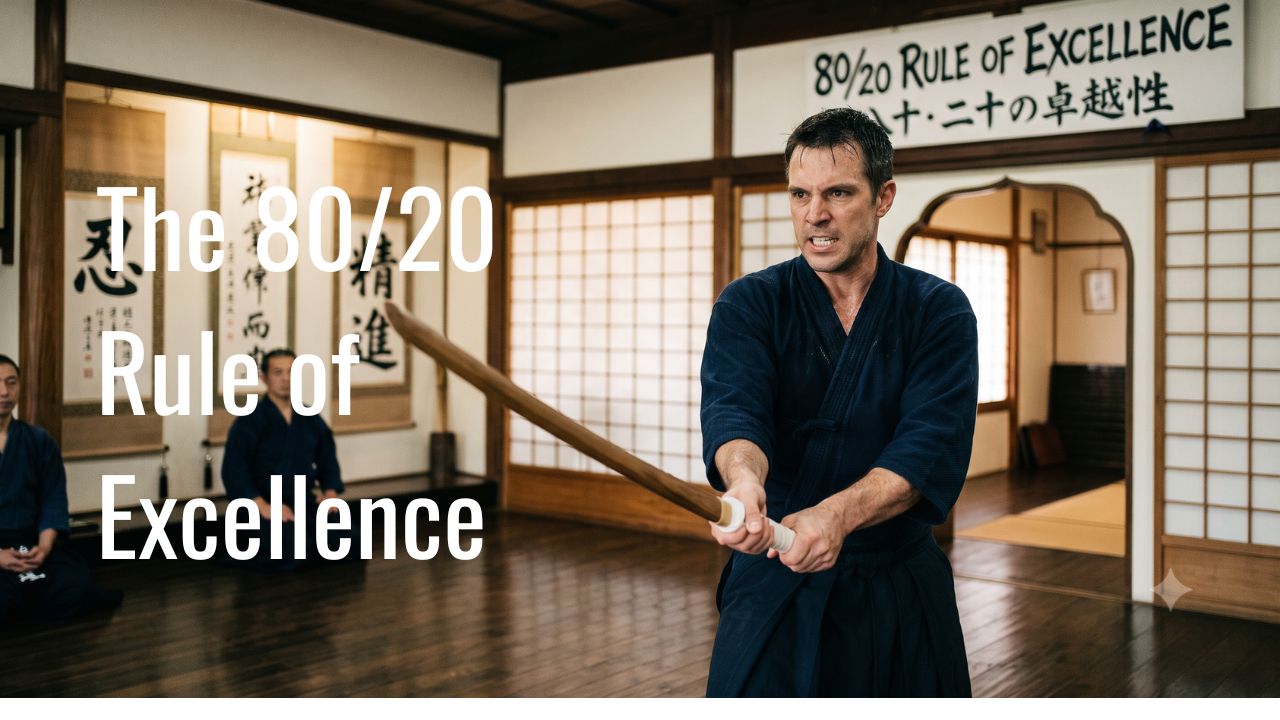
The 80/20 Rule Of Excellence
Your Mindset Is Either Building Your Future—or Stealing It
What if the biggest obstacle standing between you and the life you want isn’t your boss, your customers, your bank account, your age, your circumstances—or even your talent?
What if it’s the conversation happening inside your own head?
Because eventually, every person chasing something meaningful reaches the same place: the moment when talent is no longer enough.
The excitement wears off. The motivation disappears. The plan gets punched in the mouth. The calls aren’t returned. The scale stops moving. The relationship gets difficult. The business struggles.
And suddenly, you have a question to ask yourself and a decision to make:
“Who am I going to be when this gets hard?”
That question may determine more about your future than almost anything else.
The 80/20 Rule of Excellence
Tony Robbins has long taught that success is roughly 80% psychology and 20% mechanics.
Think about how often that plays out in the automotive industry.
Two sales consultants can have the same inventory, same CRM, same leads, same managers and the same 24 hours in a day. One builds a thriving book of business while the other spends the month making excuses about why nobody is buying.
The difference often isn't knowing what to do. It's doing it anyway, especially when you don't feel like it.
Skills matter. Training matters. Process matters enormously. But none of them can save you if your mindset continually negotiates you out of using them.
The greatest sales process in the world is useless if you won't pick up the phone. The perfect workout doesn't work if you don't show up to the gym. Communication techniques can't repair a relationship if your ego refuses to have the conversation.
Skill gives you the tools. Mindset determines whether you'll use them.
When Life Says, “Let’s See What You’ve Got”
David Goggins' Can't Hurt Me is built around an uncomfortable idea: human beings routinely underestimate what they're capable of, because the mind starts begging for relief long before our true capacity has been exhausted.
His story isn't powerful because suffering itself is admirable. It's powerful because of what can happen when we stop treating discomfort as proof that we should quit.
Sometimes discomfort means you're failing. But sometimes…It means you're training.
That applies directly to the dealership:
The uncomfortable prospecting call. The customer who told you no yesterday. The role-play you hate. The manager conversation you've been avoiding. Learning technology that makes you feel like your grandparents trying to program the VCR (in case you’re wondering, that’s the gadget that saved videos on a giant cassette-tape and let you play them on your TV).
Those moments aren't interruptions to your development. They ARE your development.
Every time you keep a promise to yourself when quitting would be easier, you create evidence that you're becoming someone stronger.
Embrace the Suck—Together
Brent Gleeson's Embrace the Suck brings lessons from the SEAL environment into another vitally important element of success: resilience isn't simply individual toughness.
High-performing teams develop cultures of accountability, trust, preparation, adaptability and shared purpose.
That's incredibly relevant inside a dealership. Nobody creates an exceptional customer experience alone.
Sales needs the desk. The desk needs finance. Sales needs service. Service needs parts. Everyone needs leadership—and leadership damn well needs everyone else.
When departments operate like rival countries with questionable diplomatic relations, the customer feels it. But when people stop asking, “Is that my job?” and start asking, “What does the team need from me right now?” performance changes.
So does culture. So does the customer experience.
Your Mindset Follows You Home
Here's where this gets bigger than selling cars:
You don't have a “work mindset” and a completely separate “life mindset.” You bring yourself with you EVERYWHERE. You know the saying? “No matter where you go…there you are!”.
*The discipline that makes the follow-up call is the same discipline that gets you into the gym when you'd rather stay on the couch.
*The humility that allows you to hear a customer's objection without getting defensive is the same humility required to listen to someone you love say something you may not want to hear..
*The resilience that gets you through a brutal month is the resilience you'll need when life delivers something much harder than just a bad commission check.
Excellence becomes an identity. Not perfection. EXCELLENCE. There is a massive difference between the two..
The Auto Dojo Standard
This is at the heart of Auto Dojo: The Path to Excellence.
*Integrity when nobody is watching.
*Relentless progress when progress feels painfully slow.
*Endless curiosity when you realize what worked yesterday may not be enough tomorrow.
*Respect for the individual.
*Passion.
*Leading by example.
*Joy—even while doing difficult things.
*And supporting the people around you while still challenging them to become better.
A dojo isn't a place where you arrive already being a master, it's where you train.
You stumble. Learn. Practice. Get uncomfortable. Improve. Then train again. And life isn't much different.
Decide Who You're Becoming
So here's your challenge:
Identify one place in your life where you've been negotiating with yourself. Maybe you've blamed the leads. Skipped the workout. Avoided the conversation. Stopped learning. Ignored your finances. Lowered the goal because achieving it suddenly looked harder than you expected.
Now ask yourself:
“What would the strongest version of me do next?”
Then do that.
Not Monday. Not when motivation magically descends from the heavens accompanied by inspirational background music.
TODAY.
Make the call. Have the conversation. Do the workout. Study the skill. Ask for help. Apologize. Try again.
Because the goal isn't merely to sell more cars, service or parts, make more money or earn another promotion.
It's to become the kind of human being capable of creating an extraordinary life—and strong enough to keep building when life refuses to cooperate.
Your skills determine what you know how to do.
Your mindset determines who you become when doing it gets hard.
Train both. But never underestimate the more important one of the two that lives between your ears.